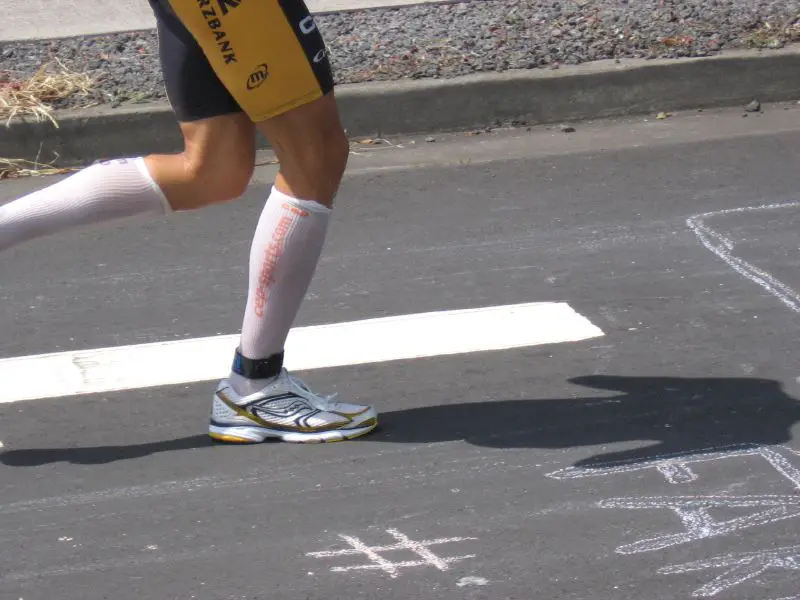
 Compression socks are the newest rave on the triathlon scene as people seek every advantage and benefit possible through the best gear.
If you watched any of the Kona Ironman on TV, you noticed that many of the elite triathletes were wearing compression socks.
Even triathlon guru, Joe Friel, discussed the issue of compression socks on his blog.
So, what follows is a crash course on compression socks to bring you up to speed and help you make an informed decision about using them.
How Compression Socks Work
The unique characteristic of compression socks is their graduated pressure application.
The body pumps blood to all of the extremities as equally as it can. Over time, however, gravity often causes blood to pool in the lower legs and feet, causing circulatory problems. This blood pooling can cause fatigue and leg cramps.
This is where compression socks come in. Compression socks use stronger elastics to create significant pressure on the legs, ankles and feet. Compression socks are tightest at the ankles, gradually becoming less constrictive towards the knees. By compressing the surface veins, arteries and muscles, the circulating blood is forced through narrower channels. The arterial pressure is increased, causing more blood to return to the heart and less blood to pool in the feet.
Although compression socks were originally marketed to those with compromised circulatory systems, many people now find their everyday use beneficial. For example, passengers on long air flights wear compression socks to prevent circulatory problems like deep vein thrombosis, leg cramps and edema. Those with occupations requiring long periods of standing have also found the use of compression socks to be helpful. Compression socks have been widely accepted in clinical and post-surgical settings for the treatment of edema, lymph edema, phlebitis, varicose veins, spider veins and deep vein thrombosis.
Long Distance Runners Wear Compression Socks
Compression socks found their way into long-distance running.
Running legends such as Lornah Kiplagat, Gete Wami, and Paula Radcliffe swear by them.
It is believed their benefit to running includes:
- improved oxygen delivery to muscles
- accelerated lactic acid removal
- stabilization of the lower leg for greater muscle efficiency
- enhanced venous return to the heart through a more efficient calf muscle pump, leading to increased endurance capacity
- cramp prevention
- minimized muscle fatigue as a result of more compact muscles, which enhances balance and proprioception and reduces muscle fatigue
How Compression Socks Help Triathletes
So you can see why a triathlete would be interested in compression socks.
The run portion is the last segment of triathlon and is normally when fatigue and cramps become an issue.
A triathlete also logs a lot of training miles on the road running. It makes sense to do whatever you can to help train and perform well, even if it means wearing those silly looking socks.
But do they really work?
Studies Of Athletes Wearing Compression Socks
 There doesn’t seem to be a conclusive answer. On the one hand, you have a lot of runners and triathletes who use them and say compression socks work for them. That shouldn’t be taken lightly. There’s no reason why they would say so if it weren’t true.
However, a study done by the American College of Sports Medicine suggests there is no statistically significant differences in maximal oxygen consumption, heart rate or minute ventilation between treadmill runners who wore compression socks and those who did not. The study did, however, show a faster lactate recovery rate after exercise when wearing the compression socks, suggesting that compression socks might speed recovery after a strenuous workout or a race. As one runner put it, “So wear them in a race if it suits you, but definitely wear them after the race.”
There is other research on the enhanced performance benefits of compression socks. James Greenwood breaks down a study done in Germany to “determine the effect of below the knee compression stockings on running performance in men runners.” The findings established a correlation between the compression socks and improved performances by the participants.
Popular Compression Socks Used By Triathletes
It appears there’s enough ammo for any triathlete to at least experiment with compression socks to see if they are beneficial.
A few of the most popular compression socks used by triathletes include:
- 2XU (more about 2XU compression socks)
- CEP (more about CEP compression socks)
- SLS3 (more about SLS3 compression socks)
What has been your experience with compression socks? Is there a certain kind you would recommend? Please share your experience it might help someone else in their decision. Thanks!